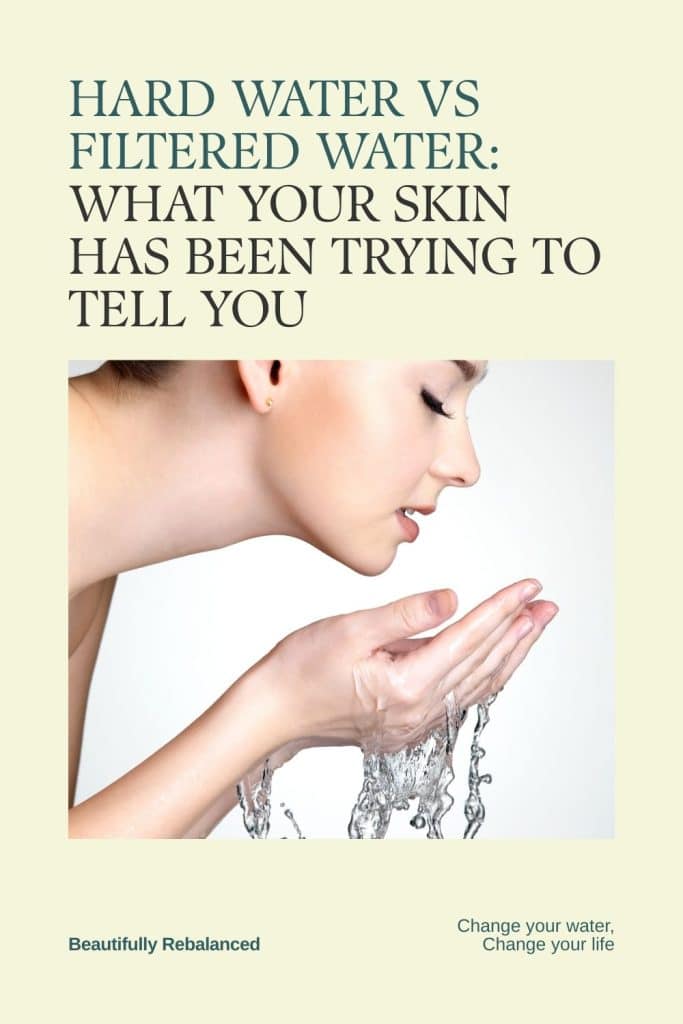

Hard Water vs Filtered Water: What Your Skin Has Been Trying to Tell You
If you've ever invested real time and money into a skincare routine — the right cleanser, a good moisturizer, maybe a targeted serum or two — and still couldn't get your skin to behave consistently, I want you to consider something you've probably never been told to look at.
The water.
Not the products. Not your diet (well, not only your diet). The water coming out of your faucet and touching your skin multiple times every single day.
I spent years trying to solve persistent skin issues with better products before I began to understand what hard water actually does to your skin at a biological level. Once I understood it, a lot of things clicked — including why some of those expensive products were delivering disappointing results despite genuinely good formulations.
Here's a thorough breakdown of what's actually happening, backed by research, with practical steps you can take regardless of where you are in your water quality journey.
Quick Takeaways
- Hard water contains elevated levels of calcium and magnesium that deposit on your skin after rinsing, disrupting your acid mantle and reducing moisture retention
- Research published in the Journal of Investigative Dermatology found that hard water exposure measurably increases your skin surface pH and reduces ceramide levels — both markers of compromised barrier function
- A major UK study published in the Journal of Allergy and Clinical Immunology found that children in hard water areas had a 44% higher odds ratio for eczema than those in soft water areas, even after controlling for other variables
- Hard water reacts with soap and cleanser to form a film that doesn't fully rinse away, leaving residue that can clog pores and cause irritation
- Filtered water removes contaminants but doesn't address mineral content — softened water addresses minerals but doesn't filter contaminants — understanding the difference matters for choosing the right solution
- Your hair is affected by the same mineral buildup as your skin, which explains why conditioners and hair products sometimes underperform in hard water areas
What Hard Water Actually Is (And Where It Comes From)
Hard water isn't a label for dirty or contaminated water. It's simply water with a high concentration of dissolved minerals — primarily calcium and magnesium — that it picked up while moving through limestone and chalk geological formations underground.
The hardness of your water is measured in grains per gallon (GPG) or parts per million (PPM). The US Geological Survey estimates that approximately 85% of American homes have hard water to some degree, with the Midwest, Southwest, and parts of the South having some of the highest mineral concentrations in the country.
You've almost certainly seen the evidence of hard water without connecting it to the source: the white chalky buildup around your faucets and showerhead, the spots on your glassware after the dishwasher runs, the film that coats your shower walls. Those are all calcium and magnesium deposits — the same minerals that are also landing on your skin every time you wash.
What Those Minerals Are Actually Doing to Your Skin
This is where it gets interesting, and where the research tells a clearer story than most skincare articles acknowledge.
When hard water contacts your skin, the dissolved calcium and magnesium ions interact with the fatty acids in your skin's natural oils and in your cleansers, forming what are essentially insoluble soap compounds — the same chemistry that creates soap scum on your shower walls. This residue doesn't rinse away cleanly. It stays on your skin's surface, creating a thin film that sits over your pores and interferes with your skin's natural function.
Beyond that surface residue, the mineral ions themselves affect your acid mantle. A 2016 study in the Journal of Investigative Dermatology found that hard water exposure was associated with measurably increased skin surface pH and reduced ceramide content in your skin. That's significant because ceramides are structural lipids that make up roughly 50% of your skin barrier — they're essentially what holds your skin cells together and keeps moisture from escaping. When your ceramide levels drop, your barrier gets leaky. Moisture escapes more easily. Irritants penetrate more easily.
The same study found that the combination of hard water and sodium lauryl sulfate (a common surfactant in many cleansers) caused significantly more barrier disruption than either factor alone — which helps explain why you might find that even gentle cleansers cause irritation when you're dealing with hard water.
A separate, large-scale UK study published in the Journal of Allergy and Clinical Immunology followed over 1,300 children and found that those living in hard water areas had significantly higher rates of eczema than those in soft water regions — a 44% higher odds ratio — even after controlling for other variables like socioeconomic status and exposure to other allergens. If your kids struggle with eczema or sensitive skin, this finding is worth taking seriously.
The Specific Ways Hard Water Shows Up on Your Skin
Recognizing the signs is the first step to understanding whether this is actually a factor for you. Hard water tends to show up as:
Persistent dryness that doesn't respond to moisturizer. If you apply lotion and it feels like it's sitting on the surface rather than absorbing, or if dryness returns quickly after moisturizing, mineral residue on the skin surface may be impeding absorption.
That tight, stripped feeling after washing. This is often interpreted as “clean,” but it's actually a sign that the natural oils meant to protect your skin have been disrupted — and that mineral residue has been left behind.
Breakouts or clogged pores that don't improve with typical acne-focused products. When mineral deposits and cleanser residue accumulate in pores daily, it creates a baseline of clogging that topical treatments are fighting uphill.
Redness or irritation that comes and goes without a clear cause. Repeated barrier disruption from hard water exposure creates a chronic low-level inflammatory state in some people, especially those with naturally sensitive skin.
Skin that consistently feels like it needs more product. If you find yourself layering more moisturizer, more serum, more everything — and still not getting results — your barrier may be compromised in a way that products alone can't fix because the disrupting input (the water) is still there twice a day.
What About Hair?
The same mineral chemistry affecting your skin is affecting your hair, and it's worth mentioning because it often amplifies the sense that “nothing is working.”
Hard water minerals deposit on your hair shafts the same way they deposit on your skin — forming a coating that makes your hair feel dry and rough, prevents conditioners from penetrating effectively, causes color-treated hair to fade faster, and over time contributes to brittleness and breakage. People who move from a hard water area to a soft water area frequently comment, unprompted, on how different their hair feels within weeks.
Hard Water vs Soft Water vs Filtered Water: What's the Difference?
These three terms get used interchangeably sometimes, but they describe different things and address different problems.
Hard water has high mineral content (calcium, magnesium). Most tap water in the US falls somewhere on the hard water spectrum.
Soft water has had the hardness minerals removed or exchanged — typically through a water softener that replaces calcium and magnesium ions with sodium ions. Soft water rinses cleanly, doesn't form soap scum, and generally feels noticeably different on skin and hair. However, a standard water softener doesn't filter out chlorine, heavy metals, or other chemical contaminants — it only addresses the mineral hardness.
Filtered water has been processed to remove contaminants — chlorine, chloramine byproducts, heavy metals, sediment, and other substances depending on the filter type. A standard carbon filter reduces many of these, but doesn't address water hardness. The minerals that cause the skin effects described above pass right through most common filtration systems, meaning your skin is still getting the full mineral load even with a filtered pitcher or under-sink system.
This distinction matters because the two problems — mineral hardness and chemical contamination — often require different solutions, and understanding which one (or both) you're dealing with determines what approach actually makes sense for your household.
Practical Steps, From Simple to More Comprehensive
The good news is that you don't have to overhaul your entire home's plumbing to start making a difference. There's a spectrum of options depending on your situation and budget.
Know what you're dealing with first. Water quality varies significantly by region and even by neighborhood. Your municipal water provider is required to publish an annual water quality report — you can usually find it on their website by searching for “[your city] water quality report” or going to the Environmental Working Group's tap water database. This will tell you your area's water hardness, pH, and what contaminants are present. Inexpensive water hardness test strips are also available online if you want a quick at-home read.
Adjust your water temperature. Hot water amplifies the stripping effect of hard water on your skin. Washing your face with lukewarm water rather than hot water reduces the degree to which minerals and soap residue bind to your skin's surface. It's a free change that makes a real difference.
Consider a shower filter or a filtered showerhead. These attach directly to your existing shower line and reduce chlorine and some other contaminants. They're relatively affordable, easy to install, and a reasonable starting point. Note that most shower filters don't significantly reduce water hardness — they address chemical contaminants more than minerals — but removing chlorine alone can reduce skin irritation for some people. You can see what I'm using in this article.
Look into a water softener for whole-home mineral reduction. If you have very hard water and persistent skin or hair issues, a whole-home water softener addresses the mineral hardness problem at the source. This is a more significant investment but protects your appliances, plumbing, and laundry in addition to your skin and hair.
Consider a combination approach for comprehensive water quality improvement. Some households use both a softener and a whole-home filtration system — addressing minerals and contaminants together. For families who care deeply about what goes into and onto their bodies, this layered approach produces the most complete result.
If you're not sure where to start or what level of improvement actually makes sense for your situation, I've put together a guide that walks through the key questions — including how to evaluate your specific water, what the different system types actually do, and how to think about cost and long-term value.
Download the Water Quality Guide →
The Bigger Picture
I think about water quality the same way I think about food quality — it's a foundational input that affects everything downstream. You can spend a lot of money on high-quality supplements while eating a poor diet and wonder why you're not seeing results. In the same way, you can invest in genuinely good skincare and wonder why it's not working — while washing your face twice a day with water that's actively disrupting the very barrier those products are trying to support.
That's not a failure of the products. It's a mismatch between the foundational input and the goal.
Getting water quality right is a form of stewardship over your home and your family's health. It's foundational in a way that no serum or moisturizer can replicate, because it's happening every day, multiple times a day, whether you're thinking about it or not.
If you want to go deeper on how different types of water interact with your skin, these posts continue the conversation:
- What Your Cleansing Water Is Actually Doing to Your Skin
- Can You Wash Your Face With Just Water?
- How Facial Cleansing Water Impacts Skin Health