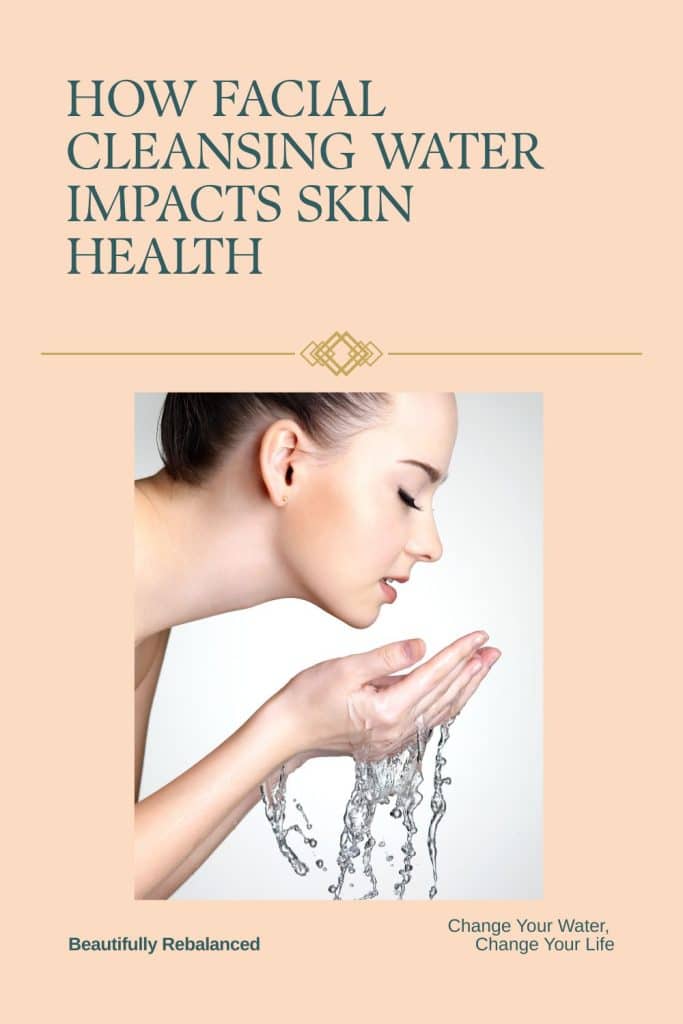
How the Water You Wash Your Face With Is Affecting Your Skin (More Than You Realize)
There's a question I wish someone had asked me years earlier, when I was spending real money on skincare products and still couldn't get consistent results:
What's in the water you're using to wash your face?
Not the cleanser. Not the moisturizer. The water itself — the thing your skin contacts before any product touches it, and the thing that rinses all of it away afterward.
Most skincare advice completely skips this. You'll get detailed guidance on active ingredients, layering order, and morning versus evening routines, but the water is almost always treated as a neutral background variable. After years of researching water quality and living through my own water upgrade journey, I can tell you with confidence: it isn't neutral at all.
Here's a thorough breakdown of how your cleansing water actually affects your skin, with the research to back it up.
Quick Takeaways
- Your skin's natural pH sits between 4.5 and 5.5 — most tap water in the US is significantly more alkaline than that, meaning every wash temporarily pushes your skin's pH in the wrong direction
- Research published in the International Journal of Cosmetic Science shows that skin surface pH below 5.0 is essential for healthy barrier function and resident skin flora — disrupting it has measurable downstream effects
- Chlorine and chloramine in tap water — added for public health reasons — can strip your skin's natural oils and alter its microbiome with repeated daily contact
- Hard water minerals (calcium and magnesium) deposit on your skin after rinsing, reduce ceramide levels, and raise your skin's surface pH, all of which compromise your barrier
- Skin barrier disruption from cleansing water is cumulative — it happens gradually through daily repetition, which is why it's easy to miss the connection
- Improving your cleansing water quality doesn't require adding more products — it addresses a root cause rather than managing symptoms
Your Skin Barrier: The Foundation Everything Else Builds On
Before getting into water specifically, it helps to understand what your skin is actually trying to do — because the water conversation only makes sense in that context.
Your skin's outermost layer, called the stratum corneum, functions as a physical and chemical barrier between your body and the outside world. It's made up of skin cells (corneocytes) embedded in a matrix of lipids — primarily ceramides, cholesterol, and fatty acids — that work together to keep moisture in and irritants out. Think of it like a brick wall, where the cells are bricks and the lipids are the mortar holding everything together.
Sitting on top of that structural barrier is the acid mantle — a thin, slightly acidic film formed by your skin's natural oils (sebum) and sweat. Research consistently places healthy skin surface pH between 4.5 and 5.5, and that acidity serves specific functions: it supports your skin's microbiome (the community of beneficial bacteria that live on your skin), regulates enzyme activity involved in natural cell turnover, and reinforces barrier integrity.
When that pH rises — toward neutral or alkaline — the barrier doesn't function as well. Moisture escapes. Irritants get in more easily. The microbiome shifts in ways that can contribute to sensitivity and breakouts. And the enzymes responsible for healthy cell shedding become overactive, leading to flaking and an uneven texture.
All of this can happen from your cleansing water alone — before a single product is applied.
What Tap Water Is Actually Doing to Your Skin
Municipal tap water in the United States is treated and regulated for drinking safety, not for skin compatibility. That's not a criticism of public water treatment — chlorination and other disinfection methods have been critical public health tools for over a century. It just means the water coming out of your faucet was optimized for a different purpose than what you're using it for when you wash your face.
Here's what's typically in your tap water and how each component affects your skin:
Alkalinity (pH 6.5–8.5, often higher in practice)
The EPA requires municipal water to fall between pH 6.5 and 8.5, and many systems run on the more alkaline end to reduce pipe corrosion. A 2002 study in Skin Research and Technology found that washing with tap water caused a measurable increase in skin surface pH that persisted for up to 90 minutes after washing — during which time your barrier function was temporarily compromised. When you wash your face twice a day, that's a lot of cumulative disruption.
Chlorine and Chloramine
These disinfectants are effective at killing pathogens in your water supply. On your skin, though, they act as oxidizing agents that can break down the lipids in your skin barrier, strip your natural oils, and alter the balance of your skin's microbiome. A 2019 study in the Journal of Dermatological Science found that chlorine exposure disrupted skin barrier function and increased transepidermal water loss (TEWL) — a key measure of how well your barrier is retaining moisture. People with sensitive skin, eczema, or rosacea tend to notice this more acutely, but it's affecting everyone to some degree.
Hard Water Minerals (Calcium and Magnesium)
Roughly 85% of US homes have hard water, meaning the water contains elevated dissolved calcium and magnesium picked up from underground geological formations. As covered in depth in my Hard Water vs Filtered Water article, a 2016 study in the Journal of Investigative Dermatology found that hard water exposure increased skin surface pH and reduced ceramide levels — both of which directly compromise your barrier. These minerals also react with your cleanser to form an insoluble residue that doesn't rinse fully, leaving a film on your skin that can clog pores and interfere with the absorption of moisturizers.
Why Your Skincare Products May Be Underperforming
This is worth addressing directly, because it's the piece that frustrated me for years.
If your skin barrier is being repeatedly disrupted by your cleansing water — its pH pushed up, its lipids depleted, its natural oils partially stripped, mineral residue left behind — then even genuinely good skincare products are working against a compromised foundation. They can help, but they're partially compensating for an ongoing problem rather than building on a stable base.
It's a bit like trying to maintain a healthy garden while something is regularly disrupting the soil. The seeds and fertilizer matter — but if the soil conditions are actively working against you every day, you're going to keep wondering why nothing is thriving the way it should.
This is why some women find that improving their water quality produces results that no product change has managed to achieve. It's not magic — it's addressing a root cause that was quietly undermining everything else.
How Different Water Types Compare
Understanding what's in your water gives you a clearer picture of what you might want to change. Here's how the most common water types affect your skin differently:
Standard tap water carries the full combination of alkalinity, disinfectants, and minerals described above. It's the baseline most skincare advice implicitly assumes, which is worth noting — many product formulations account for the fact that most users rinse with tap water.
Filtered water (through pitcher, countertop, or under-sink carbon filters) removes chlorine, chloramine, sediment, and many heavy metals, which reduces irritation from chemical disinfectants. Most standard filters don't address water hardness, meaning the mineral issue remains even after filtration. It's a meaningful improvement but an incomplete one for many people.
Softened water has had the hardness minerals exchanged for sodium ions through a water softener. It rinses more cleanly, doesn't form soap scum on your skin, and generally feels noticeably different — softer and more slippery during washing. However, a water softener doesn't remove chlorine or other chemical contaminants, so it addresses the mineral issue without resolving the disinfectant issue.
Slightly acidic water (pH 4.5–6.5) is closest to your skin's natural pH range. Cleansing with water that's already pH-compatible with your skin's acid mantle reduces the degree to which your skin has to work to rebalance after washing. A study in Skin Research and Technology found that using mildly acidic water for the final rinse significantly reduced the post-wash pH disruption compared to tap water, supporting faster barrier recovery.
For a full side-by-side comparison of how these water types interact with your skin, my Facial Cleansing Water Spectrum article goes into the details with the infographic.
The Cumulative Nature of This Problem
One reason water quality is often overlooked as a skin factor is that its effects are gradual and cumulative rather than dramatic and immediate. You don't wash your face once with tap water and wake up with a compromised barrier. It happens slowly, through thousands of repetitions over months and years.
This gradual accumulation is also why people are sometimes surprised by how significant the change feels when they improve their water quality. The shift didn't happen overnight, but it also didn't reverse overnight — the improvement unfolds in the same slow, cumulative way the disruption built up.
What this means practically: if you've been attributing persistent skin issues to genetics, hormones, diet, or aging, it's worth asking whether your daily cleansing water has been a contributing factor all along.
Where to Start
If this has prompted you to look more closely at your own water quality, the most grounding first step is simply understanding what you're actually dealing with. Your municipality is required to publish an annual water quality report — you can typically find it by searching “[your city] water quality report” — and it will tell you your area's water hardness, pH, and what's been detected in your water supply.
From there, the options range from simple (adjusting water temperature, adding a shower filter, rinsing with filtered water) to more comprehensive whole-home approaches. The Water Quality Guide I've put together walks through how to evaluate your situation and what level of improvement makes sense for your household and budget.
Download the Water Quality Guide →
Or if you're ready to explore a one-on-one conversation about what I personally use and why, you're welcome to reach out directly by scheduling a water strategy consultation here.
Continue exploring the water quality series:
- What Your Cleansing Water Is Actually Doing to Your Skin
- Hard Water vs Filtered Water: What Your Skin Has Been Trying to Tell You
- Can You Really Wash Your Face With Just Water?