7 Water Filtration Systems Compared: What Each One Actually Does (And Doesn’t Do)
When I first started researching water filtration systems for our home, I made the mistake most people make: I assumed the most expensive option was the best option, and that all filters basically do the same thing with different price tags. I also assumed the most expensive option was too far out of reach, so I focused on a compromise between what was best vs what I found most comfortable within my budget.
But, I was mistaken.
Water filtration is a category where the options genuinely solve different problems, and buying the wrong system for your specific situation is a very real possibility — whether you spend a lot of money or go for the best bargain. I've been through enough water upgrades in our home to know this firsthand, and I've spent a lot of time helping other families think through these decisions since.
What I've found is that most people aren't lacking the willingness to invest in better water. They lack a clear framework for understanding what each system actually does and doesn't do, and which combination of problems they're trying to solve.
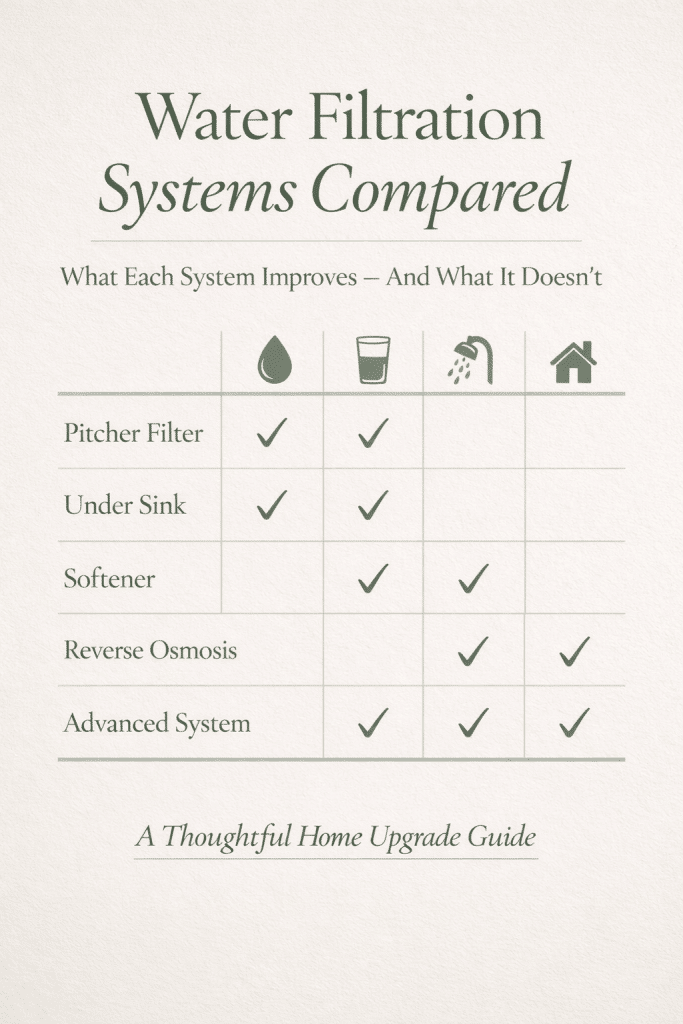
This guide gives you that framework — no vague comparisons, no “it depends” without explanation. Just an honest breakdown of seven of the most common water systems, evaluated on the same criteria for every one.
Quick Takeaways
- No single water filtration system addresses every water quality concern — understanding what each one does and doesn't remove is essential before buying
- Pitcher and countertop filters improve taste and reduce chlorine, but don't address water hardness or pH
- Water softeners reduce hardness minerals, but don't filter chemical contaminants like chlorine or heavy metals
- Reverse osmosis produces very pure water but removes beneficial minerals and typically doesn't address water hardness before the membrane, which can shorten its lifespan
- Shower filters reduce chlorine exposure on your skin and hair, but have a limited impact on water hardness
- Whole-house filtration systems address contaminants at every tap, but vary widely in what they actually filter, depending on the system, and may increase corrosion issues within your plumbing.
- Water ionizers produce water across a pH spectrum for multiple household uses and filter contaminants, but are a more significant investment — best understood as a long-term home infrastructure decision rather than a simple filter purchase
- The most effective approach for most households is a layered strategy that addresses both chemical contaminants and mineral hardness
Before You Compare: The Two Separate Problems Most Homes Have
This is the single most important thing to understand before evaluating any water system, and it's the thing that most buying guides skip entirely.
Most US households are dealing with two distinct water quality issues that require different solutions:
Chemical contamination — chlorine, chloramine, disinfection byproducts, heavy metals, pesticide residue, and other substances introduced through treatment or aging infrastructure. These are addressed by filtration.
Mineral hardness — elevated calcium and magnesium that your water picked up moving through geological formations underground. These are addressed by softening or specific filtration technologies. Standard carbon filters do not remove hardness minerals.
When you understand that these are separate problems, you can see why a single system often doesn't solve everything — and why people sometimes spend money on a filtration upgrade and still have hard water, or install a softener and still have chlorine in their drinking water.
Now, with that foundation in place — here's the honest comparison.
1. Pitcher and Countertop Filters
What they do: Pitcher filters like Brita and PUR use activated carbon to reduce chlorine, chloramine, some heavy metals (lead, copper), sediment, and certain organic compounds that cause bad taste and odor. Countertop units work on the same principle, with higher flow rates and larger filter capacity.
What they don't do: They don't remove hardness minerals (calcium and magnesium), fluoride, nitrates, or most dissolved solids. They don't change water pH in any meaningful way. The National Sanitation Foundation (NSF) certifies filters to specific standards — look for NSF/ANSI Standard 42 (aesthetic effects like taste and odor) and Standard 53 (health effects like lead reduction) when evaluating which pitcher filter to choose.
Cost range: $20–$60 for the unit, $5–$15 per replacement filter every 1–2 months, depending on usage.
Best fit: A household that wants to reduce chlorine taste and odor in drinking water at low cost and low commitment. A solid starting point if you've never addressed water quality at all.
Real limitation: If your primary frustration is skin dryness, scale buildup, or poor lathering — all signs of hard water — a pitcher filter won't touch those problems. It's also filtering only what you pour through it, leaving everything from your shower and cooking taps unchanged.
2. Under-Sink Filters
What they do: Under-sink carbon block or multi-stage filters connect directly to a dedicated faucet and provide higher-capacity filtration than a pitcher, with more consistent contact time between water and filter media. A good multi-stage under-sink system can reduce chlorine, chloramine, heavy metals, sediment, VOCs (volatile organic compounds), and some pharmaceutical residue. They're often NSF/ANSI 53 or 58 certified depending on the system.
What they don't do: Like pitcher filters, most standard under-sink systems don't address water hardness. They also only treat water at one tap — everything else in your home is still on unfiltered supply.
Cost range: $100–$400 for the unit, $50–$150 annually in filter replacements, sometimes more, depending on your water situation.
Best fit: A household that wants consistent, high-quality drinking and cooking water at one tap without major installation work. A meaningful upgrade from a pitcher filter, especially for families who cook from scratch and want cleaner water for food preparation.
Real limitation: If you're dealing with hard water, you'll still see scale buildup on appliances, and your shower water and skin are still getting the full mineral load.
3. Water Softeners
What they do: Water softeners use a process called ion exchange to replace hardness minerals — calcium and magnesium — with sodium or potassium ions. This eliminates the scale buildup on fixtures and appliances, improves how soap and shampoo lather, and removes the film that hard water leaves on your skin and hair. As covered in more detail in my Hard Water vs Filtered Water article, research in the Journal of Investigative Dermatology has shown that reducing hard water exposure can improve your skin's ceramide levels and surface pH — both markers of barrier health.
What they don't do: A water softener is not a filter. It does not remove chlorine, chloramine, heavy metals, VOCs, or other chemical contaminants. Your drinking water from a softened system still contains disinfectants and any other chemical contaminants present in your supply.
Cost range: $800–$2,500 installed for a whole-home system, plus salt costs of roughly $100–$200 annually.
Best fit: A household with confirmed high water hardness (above 7 GPG is generally considered hard) where scale buildup, poor soap performance, and skin and hair issues are the primary concerns.
Real limitation: Softening alone doesn't address chemical contamination. Many households find that a softener combined with a drinking water filtration system provides the most complete result — addressing both problems rather than just one.
4. Shower Filters
What they do: Shower filters attach between your shower arm and your showerhead and use KDF (Kinetic Degradation Fluxion) media, activated carbon, or Vitamin C to reduce chlorine and chloramine from your shower water. Since your skin and hair are in contact with shower water for several minutes daily, reducing exposure to disinfectants this way can make a noticeable difference, especially if you have sensitive skin or reactive hair. You're also exposing your lungs to chlorine vapor, which is highly toxic and can result in lung irritation and other health complications in sensitive individuals. Research has shown that chlorine disrupts your skin barrier and increases transepidermal water loss, plus may cause — so filtering it out at the shower is a genuinely meaningful step.
What they don't do: Most shower filters have a limited impact on water hardness. They typically don't reduce heavy metals significantly, and their effectiveness decreases fairly quickly — most need replacement every 3–6 months to maintain any meaningful filtration.
Cost range: $20–$80 for the filter, $15–$40 for replacement cartridges every 3–6 months.
Best fit: A household that wants to reduce chlorine exposure for skin and hair without a major system investment. A practical, affordable first step if your primary concern is what your shower water is doing to your skin.
Real limitation: If you have hard water, your skin and hair are still getting the mineral load even with a shower filter in place. Many people who install a shower filter notice an improvement but find they're still dealing with residual hard water effects.
You can read more about my personal experience with shower filters in this article.
5. Reverse Osmosis Systems
What they do: Reverse osmosis (RO) forces water through a semi-permeable membrane that removes a very wide range of contaminants — up to 99% of dissolved solids, including heavy metals, fluoride, nitrates, chlorine, chloramine, bacteria, viruses, and most other substances. NSF/ANSI Standard 58 covers RO systems. If drinking water purity is your primary goal, RO is one of the most thorough options available.
What they don't do: RO removes everything — including the naturally occurring minerals that contribute to taste and to water's ability to hydrate effectively. Many RO systems now include a remineralization stage to add some minerals back, which addresses the taste issue but doesn't fully replicate the mineral profile of naturally mineralized water. RO systems also produce wastewater — typically 3–4 gallons of reject water for every gallon of purified water produced — which matters from both a stewardship and water-cost perspectives. They also don't address hardness before the membrane, which can shorten membrane lifespan and require more frequent filter changes.
Cost range: $200–$600 for an under-sink unit, $50–$150 annually in filter and membrane replacements. (Ours requires changing filters every 6 months)
Best fit: A household with specific concerns about heavy metals, fluoride, nitrates, or other contaminants that carbon filtration doesn't adequately address. Also a good fit for households that have previously had well water or live in areas with documented contamination issues.
Real limitation: As I described in my own water upgrade journey, we had an RO system for years and found that despite drinking more water than ever, we didn't feel well-hydrated. The research on why this happens is worth understanding — demineralized water behaves differently in the body than naturally mineralized water, and for some people, the difference is noticeable.
6. Whole-House Filtration Systems
What they do: Whole-house (or point-of-entry) systems treat all the water entering your home before it reaches any tap, shower, or appliance. Depending on the media used, these can reduce chlorine, chloramine, sediment, iron, manganese, hydrogen sulfide, and some heavy metals throughout your entire home. Every shower, every faucet, every load of laundry, every cooking pot — all on filtered water.
What they don't do: Whole-house systems vary enormously in what they actually filter, depending on the media type used. A whole-house carbon system primarily addresses chlorine and taste — it doesn't address hardness. Some whole-house systems include multiple filtration stages, and some combine with a softener, but it's important to evaluate the specific system against the specific contaminants you're trying to reduce rather than assuming “whole-house” means comprehensive.
Cost range: $500–$3,000+, depending on system type and complexity, plus annual filter maintenance.
Best fit: A household that wants filtered water at every point of use, not just at one drinking tap. Particularly valuable if skin sensitivity, hair issues, or concerns about inhaling chlorine steam in the shower are motivating factors — all of which require more than just a drinking water filter to address.
Real limitation: Upfront cost and installation complexity are higher than point-of-use systems. As with all systems, performance is only as good as the specific filtration media — “whole-house filter” is a category, not a description of what it actually removes. Plus, you're removing the contaminants the city uses to extend the lifespan of its pipes and infrastructure, which may cause your home's water distribution system to corrode more quickly. This is ultimately why we chose not to install one.
7. Water Ionizers
What they do: Water ionizers use a process called electrolysis to separate water into acidic and alkaline streams. They also typically include a pre-filter that reduces chlorine, chloramine, sediment, and some heavy metals before ionization.
Alkaline electrolyzed water provides better hydration than bottled or purified water, can help maintain oxidative balance in healthy individuals, and supports healthy bodily functions. Research published in BMC Proceedings suggests that electrolyzed alkaline water rehydrates healthy adults after exercise more effectively than purified water. A separate study in Electronic Journal of Biotechnology found electrolyzed reduced water has superior antioxidant properties compared to hydrogen-infused water.
An example of an electrolyzed water machine is Enagic's Kangen Water that produces multiple types of water from one unit — alkaline water for drinking, neutral water for taking medications, mildly acidic “beauty water” that matches your skin's natural pH for cleansing and toning, strong alkaline water for cleaning produce and cutting grease, and strong acidic water for surface sanitation. For more info, check out my article comparing the different Kangen Water machines.
The slightly acidic beauty water (pH 4.5–6.0) matches your skin's natural acid mantle, which is the foundation of the cleansing water conversations throughout this entire blog series.
What they don't do: A water ionizer is not a whole-house system — it typically treats water at one tap. It doesn't address water hardness before the water enters the machine (though pre-filters can be added), and in very hard-water areas, additional upstream filtration may be needed. Ionizers also represent a more significant upfront investment than any other system on this list.
Cost range: $3,000–$7,500, depending on the system, with filter replacements typically $100–$160 annually. Over a 5-year period, the per-gallon cost is generally competitive with or lower than the cost of sustained bottled water consumption for a family. A family of four spends roughly $1,856 annually on bottled water, versus approximately $1,296 when you amortize the K8 machine cost and maintenance over its warranty period.
Best fit: A household taking a long-term view of home water infrastructure that wants multi-use water capability, a filtration component for chemical contaminants, and is interested in the hydration and oxidative balance research on electrolyzed alkaline water. This is generally not a first-step purchase — it tends to make the most sense for people who have already done enough research to understand what they're looking for and why.
Real limitation: The upfront investment is significant. For households on a tight budget, working through earlier steps in the upgrade progression first makes more practical sense. Financing options are available through Enagic, which changes the access equation for some families.
How Most Thoughtful Households Actually Upgrade
Water improvements rarely happen in a single purchase. Most families move through something like this:
They start with a pitcher filter or basic countertop unit when they first notice taste or smell issues. At some point, they upgrade to an under-sink filter for more consistent drinking water. Hard-water frustrations eventually prompt them to install a softener or explore more comprehensive options. And along the way — often after doing more research into what's actually in their water and how it's affecting their family's health — they start thinking about longer-term infrastructure rather than just the next incremental fix.
There's nothing wrong with that progression. Each step builds genuine understanding. The caution I'd offer is simply this: if you're on your second or third system and still not satisfied, it may be worth stepping back and evaluating whether the incremental approach is actually getting you to where you want to go — or whether a more intentional long-term strategy would serve your family better from both a wellness and a financial stewardship standpoint.
That's exactly the kind of thinking I walked through in the water upgrade journey post, if you want a more personal take on how that process actually felt.
Not Sure Which Direction Is Right for Your Home?
The Water Quality Guide I've put together walks through the key questions to ask about your specific water — including how to get your water tested, how to interpret hardness and contaminant levels, and how to think through which combination of solutions addresses your actual situation rather than just the most popular one.
Download the Water Quality Guide →
If you're further along in your research and want to talk through your specific situation, you're welcome to reach out directly to schedule a water strategy call.
Related reading in this series:
- Hard Water vs Filtered Water: What Your Skin Has Been Trying to Tell You
- How the Water You Wash Your Face With Is Affecting Your Skin
- Why We Kept Upgrading Our Water (And What Finally Made Us Stop)
- Where to Start When Rethinking Your Home Water