What Your Cleansing Water Is Actually Doing to Your Skin (The PH Spectrum Explained)
I used to have a pretty solid skincare routine. Nothing fancy — just the kind of careful, intentional approach you'd expect from someone who reads ingredient labels and avoids synthetic additives. As a natural health educator for over a decade, I thought I had it figured out.
Then I started learning more about water pH, and I realized I'd been overlooking something that touched my face several times a day, every single day.
Not a serum. Not a cleanser. Just my water.
If you've ever felt like your skin never quite settles — that tight, stripped feeling after washing, the dryness that comes back no matter what you moisturize with, the sensitivity that flares for no obvious reason — there's a good chance the water you're cleansing with is at least part of the story.
Here's what the science actually says, and why it matters more than most skincare conversations acknowledge.
Your Skin Has a PH — and It's More Acidic Than You Think
Most people learned in school that neutral pH is 7.0. What most people weren't taught is that healthy skin doesn't want to be neutral.
Your skin's surface is protected by something called the acid mantle — a thin, slightly acidic film made up of sebum, sweat, and natural moisturizing factors. A 2006 study published in the International Journal of Cosmetic Science found that natural skin surface pH is actually below 5 on average — lower than many people assume — and that this acidity is essential for healthy resident skin flora and barrier function.
This acidity isn't incidental. It serves a real purpose. The acid mantle supports the skin's natural microbiome — the balance of beneficial bacteria that live on your skin's surface — and it helps regulate the enzyme activity involved in natural skin cell turnover. It also reinforces the skin barrier that keeps moisture in and irritants out.
When skin pH is disrupted — pushed too high or too low — the barrier starts to break down. Moisture escapes more easily. Irritants penetrate more easily. The microbiome shifts. And your skin has to spend energy restoring its natural balance rather than simply maintaining it. A 2024 review in the Journal of Investigative Dermatology confirms that shifts in skin pH can disrupt barrier properties and have been increasingly linked to dermatologic disease processes.
Where Water Fits In
Here's the part that almost never comes up in skincare discussions: water has a pH, too.
Most municipal tap water in the United States is regulated to fall between pH 6.5 and 8.5, with many systems landing on the higher, more alkaline end of that range. That's by design — slightly alkaline water is less corrosive to pipes and infrastructure. Good engineering. Less ideal for skin.
That means the water touching your face during cleansing is meaningfully more alkaline than your skin's natural surface. And that gap has consequences.
The same 2006 Lambers et al. study noted that even plain tap water — which in Europe typically has a pH of around 8.0 — raises skin pH for up to six hours after contact, before it returns to its natural level. That's twice-daily disruption (sometimes more), every single day, with incomplete recovery time in between for many people.
A 2015 PubMed review on the importance of acidification in atopic eczema found that skin pH in patients with atopic dermatitis is often elevated into the neutral-to-basic range, and that this shift contributes significantly to the condition's symptoms. The authors concluded that maintaining normal skin pH is an important — and frequently overlooked — factor in understanding and managing skin barrier conditions.
None of this means tap water is dangerous. It means that if you're washing your face twice a day with water that raises your skin's pH, your skin is spending part of every day working to rebalance. In some people, that recovery remains incomplete before the next wash.
The Spectrum: How Different Water Types Interact With Your Skin
Not all water has the same pH, and not all water interacts with skin the same way. Here's a practical breakdown of the most common types:
Tap Water (typically pH 6.5–8.5, often on the higher end)
Convenient and accessible, but the alkalinity can temporarily disrupt the skin's acid mantle with repeated use.
Hard tap water — which contains higher concentrations of calcium and magnesium — compounds this effect. A 2018 study by Danby et al. in the Journal of Investigative Dermatology found that living in a hard water area is associated with an increased risk of atopic dermatitis. The research showed that hard water causes significantly higher surfactant deposits on skin after washing, increasing transepidermal water loss and causing irritation — particularly in people with a predisposition to barrier impairment. Ceramides are a key component of the skin barrier, and this disruption directly affects their function.
Distilled or Purified Water (typically pH 5.5–7.0)
Removing minerals and impurities can bring pH closer to neutral or slightly acidic, which is gentler on the acid mantle. However, distilled water lacks naturally occurring minerals, and some research suggests that very mineral-free water may actually draw trace minerals out of the skin through osmosis over time. It's an improvement over high-alkaline tap water for many people, but not necessarily the complete picture.
Softened Water (typically pH 7–8)
Water softeners exchange calcium and magnesium ions for sodium ions, reducing the hardness minerals that cause buildup and surfactant deposits. The Danby et al. study found that water softening by ion exchange did mitigate the negative effects of hard water on skin. That said, softening alone doesn't significantly lower pH, so the alkalinity concern remains.
Slightly Acidic Water (pH 4.5–6.5)
Water in this range is closest to the skin's natural pH. Research suggests that cleansing with slightly acidic water may help preserve the acid mantle and support barrier function more effectively than alkaline water. A 2008 study in the Journal of Wound, Ostomy and Continence Nursing found that skin pH increased with all washing techniques tested, but the disruption was measurably lower when cleansing products matched the skin's natural acidic range. This is the principle behind several professional skincare applications that use pH-adjusted water or acid-balanced toning protocols.
What This Means Practically
If you're someone who approaches wellness intentionally — reading labels, choosing products carefully, cooking from scratch — this has some real practical implications.
Your water may be working against your skincare products. If you're investing in quality, minimal-ingredient skincare and still not seeing the results you'd expect, the water you rinse with is worth evaluating. Alkaline water can affect how well your products absorb, how long moisture is retained, and whether your barrier stays intact between applications.
The toner step in traditional skincare routines exists partly because of water pH. A toner after cleansing is designed to restore the skin's pH before applying serums or moisturizers. If cleansing water were already pH-appropriate for skin, this step would be far less necessary. It's, in part, a correction applied after the fact.
Hard water adds another layer of complexity. If you live in an area with hard water — which is most of the United States — you're dealing with both alkalinity and mineral deposit issues simultaneously. Those minerals interact with cleansers to form a residue on the skin that further compromises barrier function, as Danby's research clearly demonstrates.
Skin type affects how much this matters for you personally. People with naturally oilier skin tend to have a slightly lower baseline pH and may recover from alkaline water exposure more quickly. People with dry, sensitive, or compromised skin are more likely to feel the effects because their barrier is already working harder.
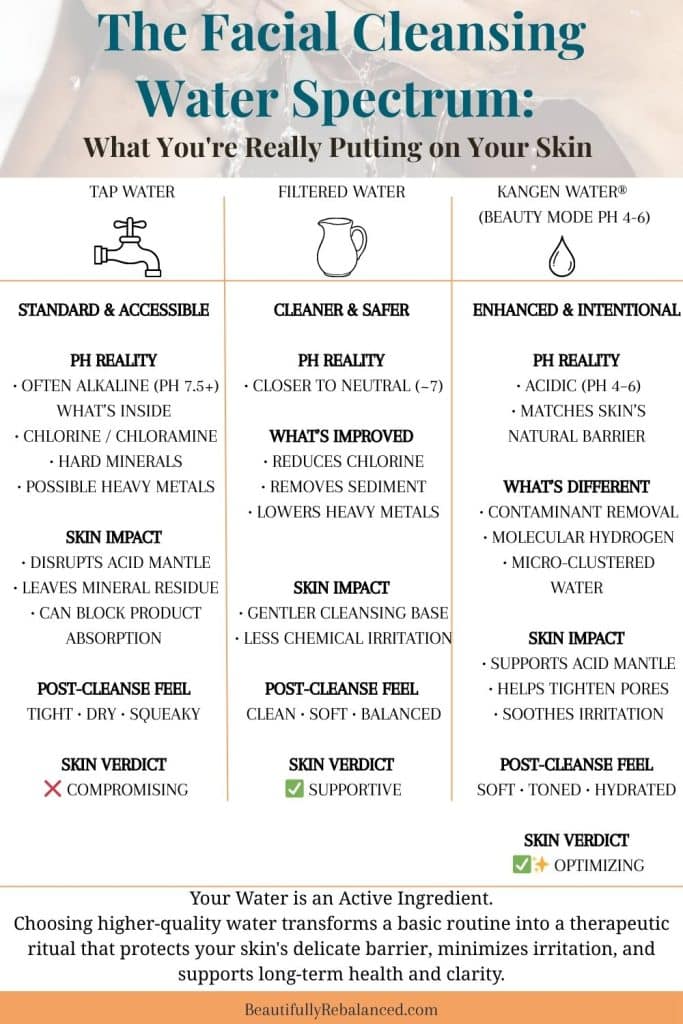
The Infographic: A Visual Comparison
The graphic below gives you a side-by-side look at how different water types compare across pH range, general effect on the acid mantle, and practical considerations for daily cleansing. Save it for reference — it's a helpful visual to come back to.
On Simplifying Rather Than Adding
One of the things that shifted for me as I learned more about water quality is that this isn't about adding more steps to a skincare routine. It's actually about getting a foundational input right so that your skin can do more of what it's already designed to do — without constant intervention.
That kind of thinking fits naturally with a holistic approach to wellness. You're not trying to override your body with products. You're trying to give it what it needs to function well on its own.
If your cleansing water is working with your skin's natural pH instead of against it, you may find that you need fewer products to compensate. Fewer toners. Fewer heavy moisturizers layered over a disrupted barrier. Fewer targeted treatments for sensitivity that's being driven, at least in part, by something environmental. Plus you'll enjoy the mental and emotional benefits of seeing less clutter on your vanity or countertop, or in your medicine cabinet, and the financial benefits of no longer needing to purchase those extra products.
There's a kind of simplified stewardship involved in using fewer inputs and trusting your body's design more that feels very liberating and rewarding.
Where to Go From Here
If you're curious about your home's water quality and how it might be affecting your skin and your family's health, a practical next step is understanding what you're actually working with. Water quality varies significantly by region, source, and season — and most households have never had their water quality evaluated.
If you don't know where to start with having your water evaluated, the Environmental Working Group has a comprehensive database of water quality reports for most locations, available here.
I've put together a guide that walks through the key questions to ask about your home water, including pH, hardness, filtration options, and how to think through what level of improvement makes sense for your household and budget.
Download the Water Quality Guide →
You might also find these related articles helpful as you think this through: