Why We Kept Upgrading Our Water (And What Finally Made Us Stop)
I'll be honest with you — I didn't set out to become someone who thinks deeply about water quality. I set out to be a good steward of my family's health. Water just happened to be where that journey kept leading me back.
If you're anything like me, you've probably already spent more money than you'd like to admit trying to “solve” your water. A filter here, an upgrade there, a subscription to something promising better hydration. And yet somehow, you're still not sure you've actually solved anything.
That was us. For years.
Here's how it actually went.
We Started Where Everyone Starts — a Pitcher Filter
The Brita went on the counter, and I felt like a responsible mom. It improved the taste, it seemed like the right step, and it was affordable. I checked the box and moved on.
But the more I learned about what actually ends up in tap water — and what a basic carbon filter does and doesn't remove — the more I realized I hadn't really solved much. I'd just made the water taste better. Those aren't the same thing.
Then We Got Serious — or So We Thought
We upgraded to a countertop gravity filter. You probably know the type — the ones that look a little like a science experiment on your kitchen counter, with the reputation for being the “real” choice for health-conscious families.
And at first? I felt good about it.
But then reality set in.
Our water type meant I was constantly cleaning the filters — not occasionally, but constantly. And lifting heavy pitchers of water above my head to refill the top chamber was becoming physically difficult as my health issues worsened. I have chronic weakness that I manage carefully, and this system was fighting against me every single day instead of simplifying my life.
On top of that, I started digging into some of the filtration materials used in certain gravity filters and came across information that genuinely concerned me. I'd bought the system to reduce my family's exposure to contaminants. I didn't want to trade one concern for another.
It was around this time that I had my first real shift in thinking: upgrading your water isn't just about filtering out more. It's about understanding what your family actually needs — and whether the solution you chose is actually delivering it.
Reverse Osmosis Felt Like the Final Answer
Growing up in Arizona, RO water was just what you had. It felt like home, like the responsible adult choice, like the thing people who took health seriously did. So when we finally installed an RO system — one that also alkalizes and remineralizes the water — I genuinely thought we were done.
The water was clean. Legitimately, measurably clean. Problem solved.
Except… it wasn't.
Despite drinking more water than I ever had, I didn't feel hydrated. My family didn't either. Quite the contrary… we were feeling less hydrated. We were refilling glasses constantly, and that deep, satisfying sense of hydration just never came.
I didn't have language for it at the time. I just knew something was still off, and I couldn't shake it.
When I First Heard About Enagic (And Dismissed It)
I'd actually come across Kangen water years before any of this. I looked into it, felt the price tag land like a thud in my chest, and filed it away under “maybe someday if we ever have that kind of money.”
I want to be honest about that, because I think it's where a lot of people end up feeling stuck — myself included. I didn't reject it because I'd done deep research and found it lacking. I rejected it because, financially, it wasn't an option, so I didn't give it a fair evaluation.
I've seen that pattern in other areas of life, too. We dismiss things based on timing and comfort, not whether they're the right solution. That's a stewardship failure I've had to reckon with more than once.
What Changed Our Mind
A nurse friend I genuinely trust brought it back up. By that point, my husband and I had been through the pitcher, the gravity filter, the RO system, and were discussing whole-home filters. We had enough experience to know that we still hadn't found what we were looking for — and that kept me more open to reconsidering.
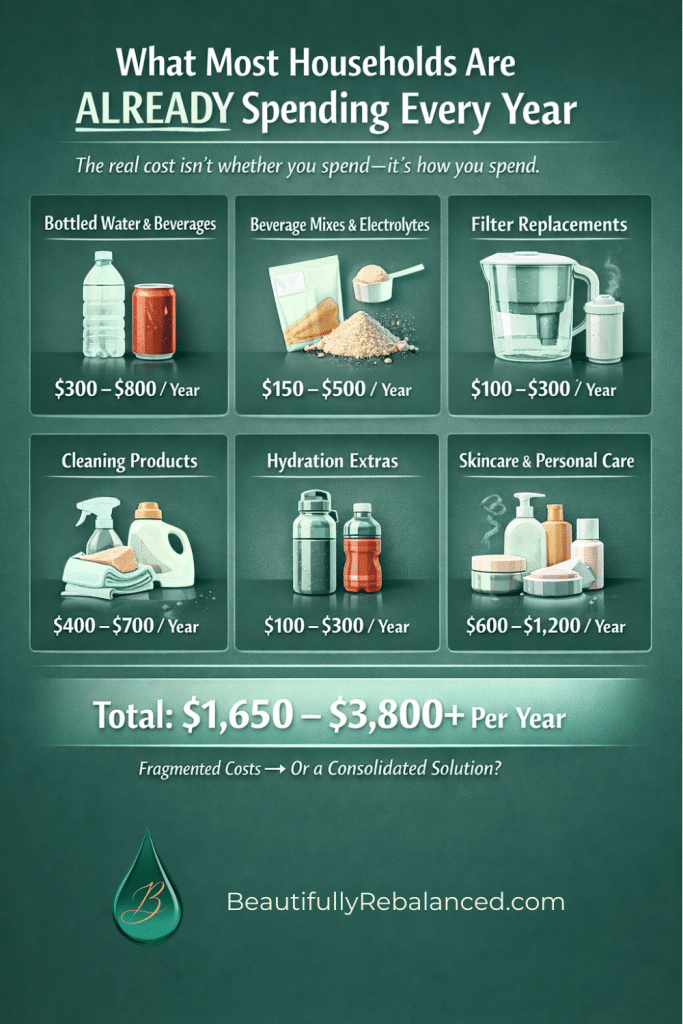
It still wasn't a financially comfortable decision. I won't pretend otherwise. But when I started actually doing the math — what we'd spent over the years on filters, hydration supplements and powders, and specialized skincare products for our hard-water issues — the picture looked different than it had when I first dismissed it.
And it didn't even take me multiplying by years… within year 1 of not needing the extras, we would see a return on investment just from money saved.
Good stewardship isn't always about spending the least money up front. Sometimes it's about stopping the slow drain.
What Actually Changed After We Made the Switch
I'm not going to tell you it was dramatic. It wasn't. It was quiet, yet consistent.
Within a few weeks, we felt the difference in hydration that I hadn't been able to achieve with the RO system, no matter how much water we drank. It was the kind of hydration that actually settles your body, rather than just giving it something extra to process.
Over the following months, other things simplified:
- We stopped buying hydration additives and electrolyte supplements
- I found myself reaching for fewer specialized hair and skincare products to compensate for our water quality
- My complexion smoothed, and my skin looked younger and healthier
- My hair felt thicker and fuller
- Digestion improved noticeably for our entire family (less gassiness, stomach uneasiness, and heaviness after eating)
- My energy became more consistent throughout the day — nothing dramatic, just steady in a way that felt different
- My productivity improved significantly
- My indoor plants showed improvement
None of these things happened overnight. And I'm not making claims about cures or magic. What I am saying is that when you remove friction from something you interact with dozens of times every day, the cumulative effect is real.
What I'd Tell Myself if I Were Starting Over
I wouldn't necessarily skip every step. Each system taught me something, and I don't know that I'd have been ready to make this decision without going through the process of ruling out the other options.
But I would ask different questions earlier.
Instead of “What's the most popular filter right now?” I'd ask: “What does my family actually need from our water — and what's the system that's built to deliver that long-term, not just hypothetically?”
That question leads somewhere different than where most of us start.
If You're in the Middle of This Process
If you're currently trying to sort through the options — filters, softeners, RO systems, alkaline systems, ionizers — and feeling like you're drowning in conflicting information, you are not alone. The wellness world has made this more complicated than it needs to be.
I've put together a straightforward guide to help you think through the landscape without the overwhelm:
Or if you're already leaning toward learning more about the system we use, you can start here:
Learn About Ionized Hydrogen Water & How It Can Help You →
You might also find these helpful: