Filtration vs Water Softening: What’s the Difference and Which Do You Need?
When you start researching home water quality, one of the first things that happens is that the terminology starts blurring together. Filtration. Softening. Purification. Ionization. They all sound like they're doing roughly the same thing — making water better — which makes it genuinely confusing to figure out what your home actually needs.
The filtration vs softening distinction is one of the most important to get clear on early, because they're solving completely different problems. Buying a softener when you need a filter, or a filter when you need a softener, is one of the most common and most expensive mistakes people make in the water improvement process.
Here's a plain-language breakdown of what each one actually does — and doesn't.
Quick Takeaways
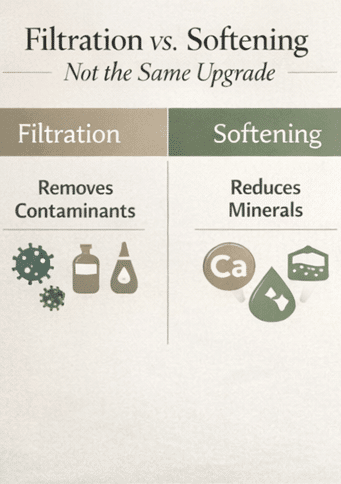
- Filtration removes contaminants from your water — chlorine, heavy metals, sediment, disinfection byproducts, and other unwanted substances
- Water softening addresses mineral hardness — specifically elevated calcium and magnesium that cause scale buildup, soap scum, and poor lathering
- A standard carbon filter does not soften water; a water softener does not filter chemical contaminants — they address different problems and cannot substitute for each other
- Approximately 85% of US homes have hard water to some degree, but hard water is not the same as contaminated water — you can have very hard water with no significant chemical contamination, or soft water with contamination concerns
- Many households benefit from both — they're complementary, not interchangeable
- Understanding which problem (or both) your home has is the starting point for any water improvement decision
What Filtration Does
Filtration is about removal. The goal is to take substances out of your water that you don't want there — things that were added during treatment, picked up through aging infrastructure, or present in your source water.
The most common targets for home water filtration include:
Chlorine and chloramine — added by municipal water systems to kill pathogens, but harsh on skin and hair with daily exposure. Standard activated carbon filters are effective at reducing both. As I covered in the how water affects your skin article, a 2019 study in the Journal of Dermatological Science found that chlorine exposure disrupts skin barrier function and increases transepidermal water loss.
Disinfection byproducts (DBPs) — formed when chlorine reacts with organic matter in water. These include trihalomethanes and haloacetic acids, which are associated with long-term health concerns at elevated levels. The Environmental Working Group's Tap Water Database is a good resource for checking whether DBPs are present in your specific water supply.
Heavy metals — lead, copper, arsenic, and others can be present in water due to aging pipes and infrastructure. Certain filter types (particularly solid carbon block and reverse osmosis) are more effective at heavy metal reduction than others.
Sediment — particles of rust, sand, or debris that cause cloudiness and can damage appliances over time.
Taste and odor compounds — organic chemicals that affect how water smells and tastes, even when it's technically safe to drink.
What filtration does not do: it does not remove water hardness. Calcium and magnesium ions pass straight through carbon filters. If hard water is your primary frustration, a filter alone won't solve it.
What Water Softening Does
Water softening addresses a completely different problem — the dissolved mineral content that makes water “hard.”
Hard water forms when water moves through limestone and chalk geological formations underground, picking up calcium and magnesium along the way. The US Geological Survey estimates that roughly 85% of American homes have some degree of hard water, with the Midwest, Southwest, and parts of the South having the highest concentrations.
Hard water isn't a contamination issue — it's a mineral content issue. Those minerals aren't harmful to drink, but they create real practical problems:
They react with soap and cleanser to form insoluble compounds — the chemistry behind soap scum on your shower walls and the film that hard water leaves on your skin and hair after rinsing. A 2016 study in the Journal of Investigative Dermatology found that hard water exposure measurably increases skin surface pH and reduces ceramide levels — both markers of compromised skin barrier function.
They deposit on fixtures, appliances, and heating elements over time — the white chalky buildup around your faucets, the scale inside your kettle, the reason your dishwasher and washing machine need periodic descaling.
They reduce the efficiency of soap and shampoo — hard water requires significantly more product to lather effectively, and the residue left behind is part of why your hair or skin often doesn't feel fully rinsed even after a thorough wash.
Water softeners work through a process called ion exchange — replacing calcium and magnesium ions with sodium or potassium ions. Softened water rinses cleanly, doesn't form soap scum, and significantly extends the lifespan of appliances. It also feels noticeably different on your skin and hair.
What a water softener does not do: it does not remove chlorine, heavy metals, disinfection byproducts, or other chemical contaminants. A softener is not a filter. Your drinking water from a softened system still contains whatever chemical contaminants were present in your supply.
Why Most Households Need to Think About Both
This is the key insight that most water advice glosses over: having one doesn't mean you've addressed the other.
You can have very hard water with minimal chemical contamination. You can have soft water from a low-mineral source area, but with significant levels of chlorine and disinfection byproducts. You can have both problems simultaneously, which is common in many US regions that have hard source water and heavily chlorinated municipal treatment.
If your main frustrations are scale buildup on fixtures, soap scum, and skin and hair that never quite feel clean after washing, that's a hard water problem, and a softener addresses it.
If your main concerns are what you're drinking and whether your water contains contaminants beyond minerals, that's a filtration problem and a filter (or, depending on your water, a more advanced system) addresses it.
If you're dealing with both — which many households are — the most complete solution addresses both. Some households use a whole-house softener plus an under-sink carbon or multi-stage filter for drinking water. Others use a combination system. The right approach depends on your specific water quality, budget, and priorities.
How to Know Which Problem You Have
The most reliable way to know is to look at your actual water. Your municipality publishes an annual water quality report — search for your city name plus “water quality report” or look up your address at the Environmental Working Group's Tap Water Database. This will show you what contaminants have been detected and at what levels.
For hardness specifically, inexpensive water hardness test strips are available online and at hardware stores. Water hardness is measured in grains per gallon (GPG) or parts per million (PPM):
- 0–3 GPG: Soft
- 3–7 GPG: Moderately hard
- 7–10 GPG: Hard
- 10+ GPG: Very hard
Most US households in hard-water regions fall within the 7–15 GPG range. At 7+ GPG, the effects on skin, hair, appliances, and cleaning are typically noticeable.
Where This Fits in the Bigger Picture
Understanding the distinction between filtration and softening is really just the starting point. Once you know which problem (or both) you're dealing with, the next question is what level of solution makes sense — and that depends on factors like your household size, budget, and what you're ultimately trying to achieve.
If you want a full breakdown of the seven most common water system types and what each one actually does and doesn't address, the 7 water filtration systems comparison covers that in detail. And if you're just starting to think about this and want a simple starting point, Feeling Overwhelmed by Water System Options? Start Here walks through the most important things to understand before evaluating any products.
Download the Water Quality Guide →
Related reading:
- 7 Water Filtration Systems Compared: What Each One Actually Does
- Hard Water vs Filtered Water: What Your Skin Has Been Trying to Tell You
- Feeling Overwhelmed by Water System Options? Start Here
- How the Water You Wash Your Face With Is Affecting Your Skin